
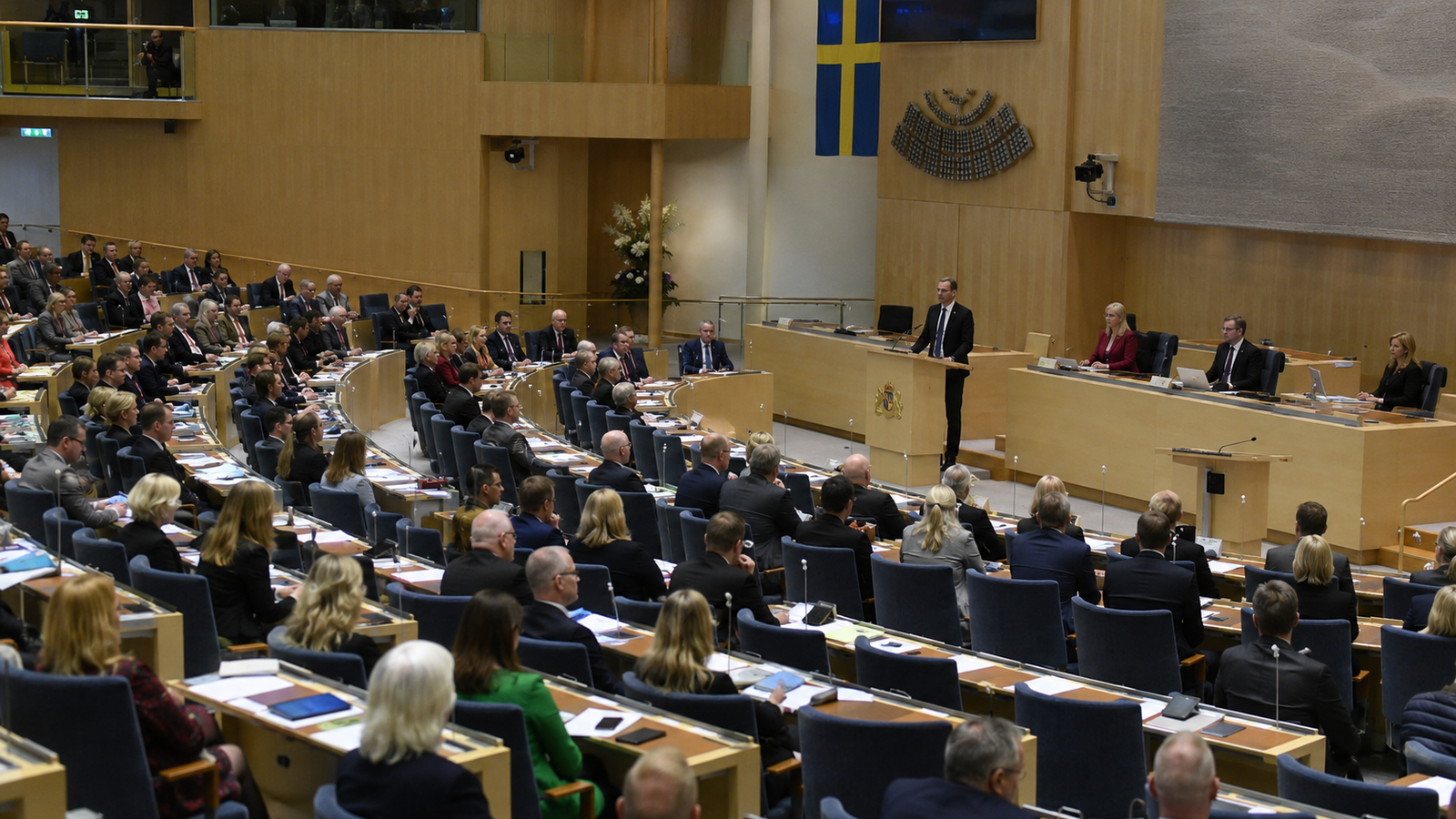

Sweden’s parliament will vote on 13 August on major changes to family immigration rules, including tougher financial requirements that would also apply when temporary residence permits are renewed. A debate in the Riksdag on Wednesday became heated as opposition MPs warned about consequences for families whose circumstances change.
The Riksdag’s Committee on Social Insurance has recommended that parliament approve the government’s proposal. If adopted, most of the legislative changes are intended to take effect on 1 October 2026.
Financial requirement would apply again at permit renewal
One of the most disputed parts of the proposal concerns Sweden’s försörjningskrav, or maintenance requirement.
Under the government proposal, the requirement would apply in more situations than today. Importantly, it would also have to be met when an application is made for a continued residence permit based on a family connection.
This means that meeting the requirement when a family member first receives a permit would not necessarily be enough. The financial situation could be assessed again when the temporary permit is due for renewal.
The government also wants to raise the financial threshold.
According to a Justice Ministry presentation, the proposed level would be based on 1.30 times the normal amount used in Swedish debt enforcement calculations, with housing costs added separately.
The government gives an example of a person who wants to bring a spouse and two children to Sweden. Under the proposed level, the person would need an income after preliminary tax of SEK 23,818 per month, in addition to enough money to cover housing costs.
The exact amount for an individual household depends on its composition and housing expenses.
Some forms of income would no longer count
The proposal also changes which income can be used to meet the requirement.
Salary would count, as would income from a business or sufficient personal assets.
Some temporary employment-related benefits, including sickness benefit and parental benefit, could also be counted.
However, income from unemployment insurance, activity support and subsidised employment would generally not be accepted when calculating whether the requirement is met.
The government argues that stronger requirements should encourage labour-market participation and self-support.
Opposition parties argue that this could create uncertainty for families when circumstances change.
The Centre Party’s motion says people should be able to change jobs, study or experience a period of unemployment without putting their family’s future residence in Sweden at risk.
Heated debate over “abortion or deportation” claim
Those concerns led to some of the strongest exchanges during Wednesday’s parliamentary debate.
Left Party MP Tony Haddou argued that the new rules could put some people in a situation where they face a choice between “abortion or deportation.”
Centre Party MP Niels Paarup-Petersen made a similar argument.
Their reasoning is that a family’s circumstances can change between the first residence permit and a later renewal. Losing a job or having another child could affect whether the financial requirement is met.
The proposed rules do not contain a provision requiring anyone to have an abortion. The phrase is a political description used by opposition MPs to illustrate what they believe could be an extreme consequence of applying the maintenance requirement repeatedly.
Moderate Party MP Viktor Wärnick strongly rejected that description during the debate.
According to TT, as published by Svenska Dagbladet, Wärnick called the rhetoric “disgusting” and argued that it is reasonable to expect someone to be able to support their family if they want family members to live in Sweden.
Social Democrat MP Ola Möller also criticised the proposal, arguing that it could make the risk of a residence permit not being renewed a recurring part of the system.
Government says stronger requirements support integration
The government takes a different view of the financial requirement.
It argues that being able to support oneself and one’s family is important for integration and participation in Swedish society.
The proposal would require the person in Sweden to have sufficient financial resources as well as housing of an adequate size and standard.
The government also says Sweden’s family immigration system should be brought closer to the minimum requirements permitted under EU law.
The Riksdag committee supports the government’s overall proposal and recommends rejecting all motions submitted in response to it.
However, the committee report contains 16 reservations from opposition parties, showing substantial disagreement over several parts of the reform.
Two-year waiting period also proposed
The financial rules are only one part of the reform.
For a family member to receive a residence permit based on a connection to a person who has a temporary residence permit in Sweden, the person already in Sweden would as a main rule have to have lived in the country with a residence permit for at least two years.
There would be exceptions, including for unaccompanied children and refugees in certain situations.
The opposition has criticised the waiting period, arguing that families could in practice remain separated for considerably longer once Migration Agency processing times are also taken into account.
The government says the changes are part of an effort to bring Swedish legislation closer to the minimum standards required by EU law.
Some young adults would receive stronger protection
Not every part of the proposal makes the rules stricter.
The government also wants to address cases involving young people who originally received residence permits in Sweden because they were children of another permit holder.
Under the proposal, a person who previously received a permit as a child and is still under 21 could in certain situations continue to receive a residence permit based on the family connection even after turning 18.
The change is intended to reduce problems involving young adults who have grown up in Sweden but lose their basis for residence when they reach adulthood.
The Centre Party is among the parties that welcome this part of the reform while opposing several of the stricter provisions.
Riksdag votes on Thursday
The debate held on 12 August does not itself change Sweden’s immigration rules.
The Riksdag has scheduled its decision for Thursday, 13 August.
The Committee on Social Insurance recommends approving the government proposal and rejecting the opposition motions. Social Democrats, the Left Party, the Centre Party and the Green Party have, however, jointly opposed several important parts of the reform.
The final outcome will therefore be decided when MPs vote in the chamber.
If the legislative proposal is approved, the main changes are planned to enter into force on 1 October 2026.
