
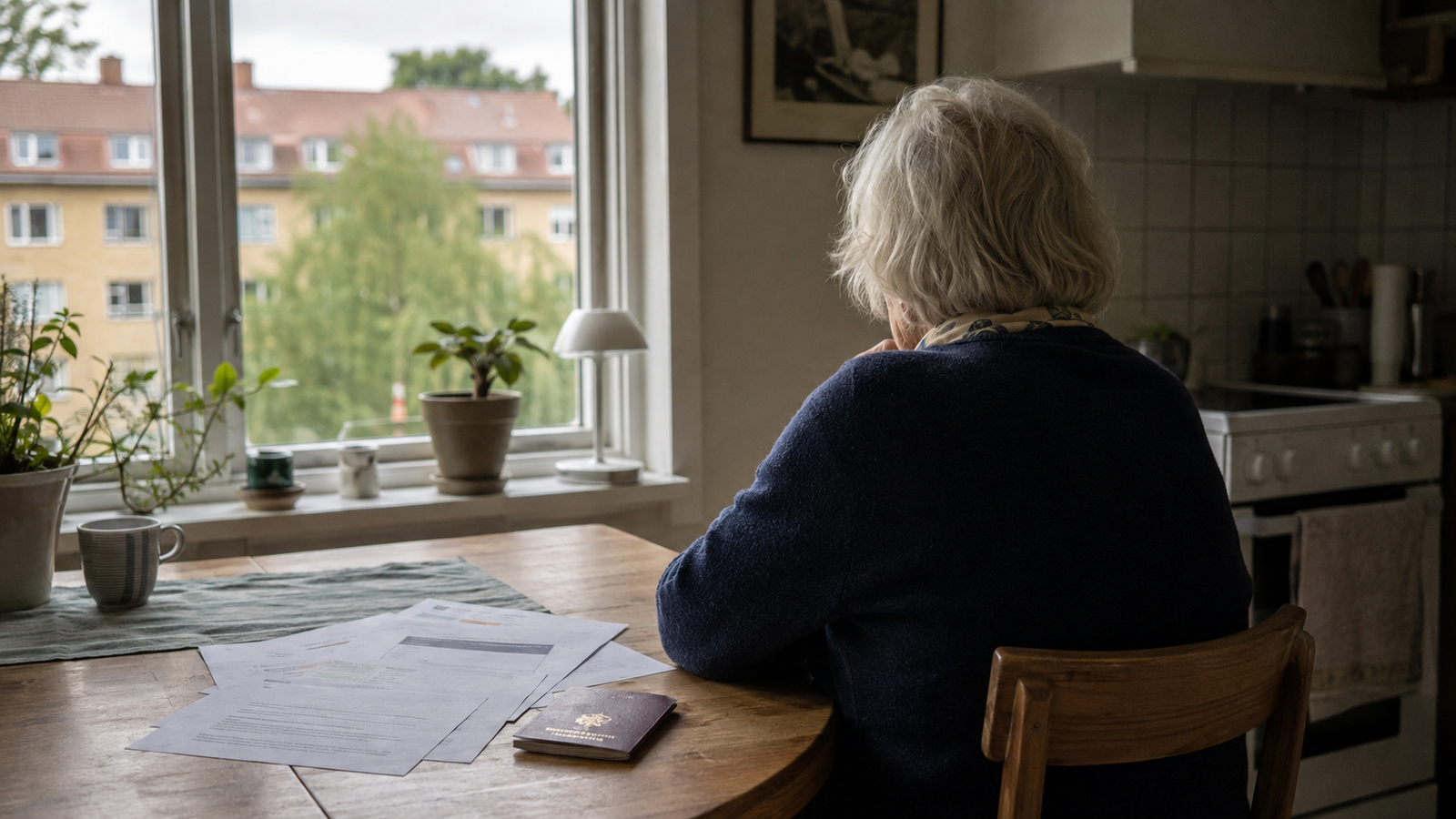

A 78-year-old British widow who has lived in Sweden for 21 years has been told to leave the country after her application for post-Brexit residence status was submitted after the deadline. Joyce Thomas has a son and grandchildren in Sweden and is now challenging the decision at a higher legal level.
Thomas, a retired nurse living in Hammarö in Värmland, says she wants to remain in Sweden for the rest of her life. Her husband, Gwynne, died from cancer in 2023 and is buried there. Her case has also drawn attention in the UK, where officials have raised wider concerns about Sweden’s handling of some late applications from British residents.
Her life has been in Sweden for more than two decades
Thomas has lived in Sweden for 21 years and has close family there, including her son and grandchildren.
After the death of her husband Gwynne in 2023, she moved from their house to a smaller apartment in Hammarö, close to both her family and her husband’s grave.
Speaking to SVT, Thomas said she wanted to spend the rest of her life in Sweden and eventually be buried next to her husband.
The problem began with the change in residence rules following the UK’s withdrawal from the European Union.
According to The Guardian, Thomas and her husband only discovered during a trip to the UK in 2022 that they should have formally applied for a new residence status in Sweden after Brexit.
Thomas said her husband had normally handled the couple’s administrative matters and followed information concerning British residents in Sweden. She believes he would have submitted the application if he had known it was required.
Her late application was rejected in 2024 after the authorities concluded that she had not demonstrated sufficient grounds for missing the deadline. A later attempt to obtain the right to remain under Sweden’s ordinary immigration rules was also unsuccessful, according to the Guardian.
She is now pursuing the case further with the help of lawyers working without payment.
Brexit changed the rules for British residents in Sweden
British citizens stopped being treated as EU/EEA citizens after the end of the Brexit transition period.
People who had been living legally in Sweden before the end of 2020 could retain rights under the EU-UK Withdrawal Agreement, but Sweden chose what is known as a constitutive residence scheme.
Under such a system, eligible residents had to apply for the new status rather than acquiring it automatically.
The European Commission’s 2024 report on citizens’ rights confirms that Sweden operates a constitutive scheme and that the application deadline was 31 December 2021.
The deadline does not mean that every later application must automatically be rejected.
The EU-UK Withdrawal Agreement requires authorities to consider the circumstances and reasons for missing the deadline. A late application must be allowed within a further reasonable period if there are reasonable grounds for the delay.
Sweden’s Migration Agency, Migrationsverket, says exceptional late applications are still possible. Applicants must explain in writing why they were prevented from applying on time.
However, the agency explicitly states that simply being registered in Sweden’s population register is not enough. It also says that claiming not to have known about the requirement to apply is not, by itself, considered a sufficient explanation. Each explanation is assessed by the agency.
Nearly 4,000 applications have been refused in Sweden
Thomas’s case has become part of a wider debate about how Sweden has applied the post-Brexit residence rules.
The latest available annual figures from the European Commission cover applications up to the end of 2024.
They show that Sweden had received 14,441 residence status applications since the scheme was launched.
Of these, 14,233 had been decided. The outcomes included:
- 8,036 grants of pre-permanent residence status
- 1,965 grants of permanent residence status
- 3,918 refusals
That means refusals represented about 27.5 per cent of decided applications.
The Commission’s figures also show that Sweden cannot provide a complete statistical breakdown separating late applications from other applications made during the reporting period. The total number of refusals therefore should not be interpreted as 3,918 people who were rejected specifically because they missed the Brexit deadline.
There are large differences between EU countries.
Belgium, which like Sweden operates a constitutive residence scheme, recorded 14,611 applications and 618 refusals in the Commission’s report.
Bulgaria recorded 17,351 applications and only five refusals. However, Bulgaria uses a declaratory system, under which the legal structure for preserving Withdrawal Agreement rights differs from Sweden’s constitutive model. Direct comparisons between refusal rates therefore need to be treated with caution.
The Guardian reports that an analysis by the UK’s Foreign, Commonwealth & Development Office found Sweden’s refusal rate to be considerably higher than the EU average and higher than in other member states. British officials believe Sweden is taking a particularly strict approach to assessing whether late applicants have reasonable grounds. This is the assessment of the UK side, rather than a conclusion made by the European Commission in its annual report.
An order to leave is not the same as a deportation
Another number reported in connection with the controversy requires an important distinction.
The Guardian, citing Eurostat figures, reports that about 2,500 British citizens have been ordered to leave Sweden since Brexit, representing around one-third of such orders involving British nationals across the EU since 2021.
This does not mean that 2,500 British citizens have necessarily been physically deported from Sweden.
Eurostat’s statistics on immigration law enforcement distinguish between third-country nationals who are ordered to leave and people who actually return following an order to leave.
The figures also cover British nationals receiving orders to leave for different immigration reasons. They do not, by themselves, establish that every one of those cases resulted from a late application under the Brexit Withdrawal Agreement.
For Thomas’s individual case, describing the decision as an order to leave Sweden is therefore more precise than suggesting that she has already been deported.
British officials have raised the case with Sweden
Thomas’s situation has also attracted the attention of Peter Kyle, the Labour MP for Hove and Portslade.
Kyle, who served as the UK’s Secretary of State for Business and Trade until 20 July 2026, described the case to the Guardian as “deeply concerning”. His former ministerial role and departure date are confirmed by the UK government.
He urged the Swedish authorities to consider Thomas’s long residence in Sweden, her family connections and the humanitarian circumstances surrounding the case.
The UK’s Foreign, Commonwealth & Development Office told the Guardian that it regularly raises concerns over the protection of British citizens’ rights with both Swedish authorities and the European Commission.
Migrationsverket’s published position remains that late applications can still be considered in exceptional cases, but applicants must provide reasons for missing the deadline that the agency considers reasonable. Lack of knowledge about the requirement is not automatically sufficient.
Thomas’s case is not yet finally resolved. According to the Guardian, lawyers assisting her pro bono are seeking to challenge the decision at a higher level of the Swedish court system.
