
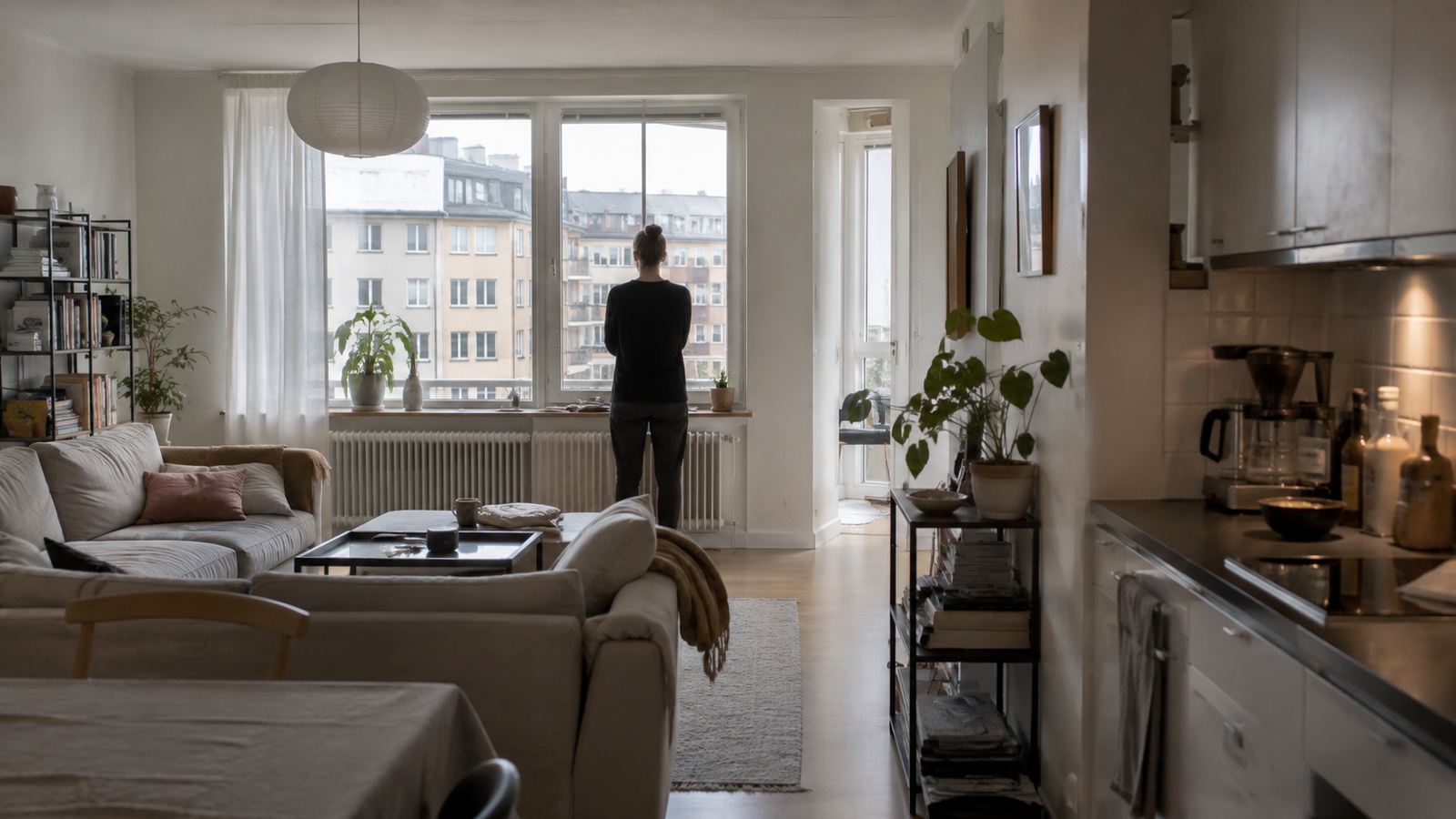

People in Sweden had an average of 42 square metres of living space per person at the end of 2025. But the national figure hides large differences: a single man aged 65 or older had an average of 80 m², while people in couples with at least three children had just 23 m² each.
The latest figures from Statistics Sweden, SCB show that age, family situation, type of home and location all have a major influence on how much space people have available.
In brief:
- Average in Sweden: 42 m² per person
- Most space: Single men aged 65+ without children, 80 m²
- Large families: Couples with three or more children, 23 m² per person
- Stockholm County: 37 m² per person
- Smallest municipal figure: Sundbyberg, 33 m² per person
Single older people have the most space
The largest homes per person are found among people living alone, particularly those aged 65 or older.
A single man aged at least 65 and living without children had an average of 80 m² of residential floor space at the end of 2025. For women in the same group, the figure was 77 m².
Younger people living alone also had considerably more space than the Swedish average. Single men under 65 had 62 m² per person, while women had 60 m².
SCB says much of the difference between younger and older single-person households can be explained by the type of housing they live in. Older single people are more likely to remain in houses, while younger people are more likely to live in rented apartments in multi-dwelling buildings.
The amount of space per person falls quickly as household size increases.
| Household type | Average living space per person |
|---|---|
| Single man 65+, no children | 80 m² |
| Single woman 65+, no children | 77 m² |
| Single man under 65, no children | 62 m² |
| Single woman under 65, no children | 60 m² |
| Couple without children | 51 m² |
| Couple with one child | 36 m² |
| Couple with two children | 30 m² |
| Couple with three or more children | 23 m² |
Source: SCB, 31 December 2025.
This means that, statistically, a single older man has more than three times as much space to himself as one person in a household consisting of a couple and at least three children.
Single fathers have more space than single mothers
There is also a clear difference between single-parent households.
People living in a household consisting of a single father and children aged up to 24 had an average of 40 m² per person. The corresponding figure for households headed by single mothers was 32 m².
SCB points to housing type as one explanation.
Among single fathers with children, 52.7 per cent of households lived in a house. Among single mothers, the largest group instead lived in rented apartments in multi-dwelling buildings, accounting for 49.7 per cent of households.
SCB also notes that households consisting of single women with children are, on average, slightly larger in terms of the number of people living in them. Both factors help explain the eight-square-metre difference.
Stockholm County has the least space per person
Where someone lives also makes a significant difference.
People in Stockholm County had an average of 37 m² of living space per person, the lowest figure among Sweden’s 21 counties. That is five square metres below the national average.
SCB links this partly to the housing structure in the Stockholm region. Only 25 per cent of households in the county live in houses, the lowest share in Sweden. Apartments in multi-dwelling buildings are much more common.
The difference becomes even clearer at municipal level.
Of Sweden’s 290 municipalities, Sundbyberg had the lowest average living space at 33 m² per person. Stockholm municipality and Solna were also among the municipalities with comparatively small residential floor areas per resident. SCB’s statistical database gives Solna an average of 35 m² per person.
At the other end of the scale were Ydre in Östergötland and Åsele in Västerbotten, where residents had an average of 56 m² per person.
At county level, people in Kalmar and Värmland had the most space, with an average of 48 m² per person. Blekinge, Kronoberg, Dalarna, Jämtland and Västernorrland followed at 47 m².
Living in an owned house means considerably more space
The type of home is another important part of the picture.
People living in privately owned houses had an average of 48 m² per person, the highest figure among the main housing categories measured by SCB.
People living in houses classified as a bostadsrätt, Sweden’s co-operative housing form, had an average of 41 m². The same figure applied to rented houses.
In multi-dwelling buildings, residents of bostadsrätt properties had around 40 m² per person, while people in rental housing had 35 m².
The lowest figure was found in special housing, a category that includes student accommodation, housing for older people and certain other specialised residences. There, the average was 29 m² per person.
| Type of housing | Living space per person |
| Privately owned house | 48 m² |
| Bostadsrätt house | 41 m² |
| Rented house | 41 m² |
| Bostadsrätt in multi-dwelling building | 40 m² |
| Rental apartment in multi-dwelling building | 35 m² |
| Special housing | 29 m² |
Source: SCB.
The difference between a person living in an owned house and someone renting an apartment in a multi-dwelling building is therefore about 13 m² per person.
Sweden now has more than five million households
The figures also reflect a longer-term change in the way people live in Sweden.
There were 5,002,559 households in Sweden at the end of 2025, according to SCB’s detailed housing statistics. The statistical news release rounds the figure to 5,002,600, around 30,600 more than a year earlier.
At the same time, the average household has become slightly smaller.
The average household size fell to 2.11 people in 2025, the lowest level since the current household statistics began in 2011. At that time, the average was 2.18 people.
The most common household type is now a person living alone without children. Such households accounted for 42 per cent of all households in Sweden at the end of 2025.
Couples without children made up 24 per cent, while couples with children aged up to 24 represented around 20 per cent.
The national average of 42 m² per person therefore describes only the middle of a very wide range. In practice, the space available to someone living in Sweden varies substantially depending on whether they live alone or with children, whether their home is a house or an apartment, and whether they live in Stockholm or in a smaller municipality.
